.png)
Stitches Without the Scars: A New Approach to Facial Wound Closure
- Omar Sultani

- Jan 5
- 5 min read
This blog post aims to simplify the following scholarly research article:
Zip Stitch Adhesive Bandage for Maxillofacial Wounds - An Evaluative Study, published in the Journal Annals of Maxillofacial Surgery
Many people obtain scars in a variety of areas throughout their lifetime. Of the many areas, the face continues to be one of the most sensitive and requires extra delicacy and carefulness when tending to it, with being the center of your appearance. That leaves you with the question: What is the best way to go about healing the injury, and with the least possible amount of scarring? Surgeons think about this same thing, however, with the added responsibility of making sure the wound heals safely and remains free of infections. Traditional stitches work, but come with their own set of problems such as visible marks, risks of infection, and discomfort during the removal process. Due to this, the search for better closure methods has become a growing area of interest in the area of maxillofacial surgery.
A newer option known as Zip Stitch has been getting attention in other surgical fields. It is a tape - like closure device that pulls skin edges together without the use of needles. Despite its use in orthopedics, gynecology and pediatric surgery, almost no research has been completed on its efficiency on the face. A team of researchers in India decided to test it in this specific region, where for many, cosmetic results matter the most. Their 2025 study gives the first structured look at how Zip Stitch performs on facial wounds and whether it can catch up or even outperform other traditional sutures.
When would Zip Stitch be used?
Suturing an open wound is a delicate process. If something goes wrong, it can leave the patient with life long scarring, or even worse, a life threatening infection. There are 3 different types of skin closure methods for healing an open wound: Sutures, staples, and adhesive tapes. Sutures remain the most common method because they are strong and reliable. Still, they can leave stitch marks and cause small infections at the puncture points. Staples are faster and safer for the person that is placing them, but they can be uncomfortable and often leave noticeable marks. Adhesive tapes and glues offer better comfort and less scaring, but do not work well on deep or high tension wounds.
The idea behind Zip Stitch is to bridge these gaps. The device was originally developed in Germany in 1989. It attaches to the skin using adhesive strips that connect through a small zip mechanism. When it is tightened, the edges of the wound come closer together and more importantly, evenly.
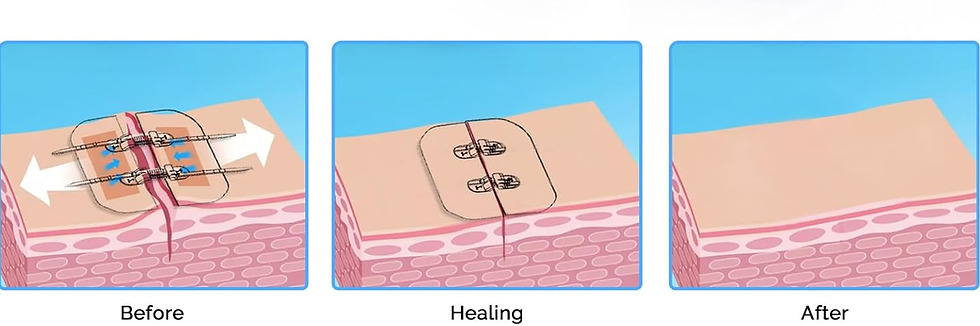
Since the device sticks to the surface instead of entering the skin, it avoids needle trauma, reduces infection risk, and is easy to remove later. Although this technology is used for other types of surgery, it hasn’t been explored for face wounds. Facial wounds are unique because the skin moves constantly and appearance matters more, which makes this an even more meaningful area to study.
The Research:
The authors conducted a pilot study on 15 patients who had either facial lacerations or needed surgical incisions in the maxillofacial area. Eleven of these patients had trauma related wounds, while 4 had planned surgical cuts. Anyone with existing medical conditions was excluded so results would be clearer and easier to interpret.
The device that was used was the Mediss Zip Stitch, which comes with 3 adhesive units in a sterile package. Each unit is 45 millimeters long and 10 millimeters wide. The internal layers of deeper wounds were still closed with dissolvable sutures, but the skin surface was entirely closed with Zip Stitch.

The researchers noted that the device allowed them to pull the skin edges together with even pressure, which also created a slight upward lift on the edges. The small lift is actually helpful, since raised edges tend to heal more smoothly.
Many different tests and score scales were used to monitor progression with the results of ZipStitch such as the ASEPSIS score, the Modified Hollander Scale, The Vancouver Scar Scale and Patient and Observer Scar Assessment (POAS). To track healing, the researchers used a post-operative wound infection scale called the ASEPSIS score. The modified Hollander scale measured how well the edges stayed aligned and how normal the healing looked by day 7 and day 15. For scarring, they used the Vancouver Scar Scale which looks at color, height, and pliability. They also used the Patient and Observer Scar Assessment Scale, which collects both Surgeon and patient opinions on appearance, comfort, and scar quality. All of the evaluations were done by two oral and maxillofacial surgeons. Data was analyzed with a paired t test at a 95% confidence level.
The results were consistently positive across all patients. ASEPSIS scores on day 3 and day 7 were low, which implied clean healing and low complications. Hollander scores also showed that the wounds remained aligned, closed, and free of separation. Scarring outcomes were encouraging, Vancouver scores started at an average of 5.8 on day 15 and improved to 4.2 by day 30, suggesting relatively mild scarring. POAS scores showed that both the surgeons and patients believed that the scars looked and felt better over time. By day 60, the average POAS score had dropped to 15.3, which represented a significant improvement compared to previous stages.
The device stayed attached for a full week in nearly every patient. Only one person experienced partial detachment, but even in that case the wound did not reopen or develop any infection. The removal was simple and painless. None of the patients has allergic reactions or skin irritation from the adhesive.
The study also briefly mentioned cost. The price of ZipStitch is similar to the price of sutures and skin staplers, which means that cost alone is not a barrier. It was pointed out by the authors that avoiding complications or return visits may make the device even more economical in the long run.
The researchers compared their results to previous studies that involved zipper style devices from other medical specialties. Those studies found similar benefits such as lower infection risks, better cosmetic results, and evenly distributed tension. One point that the authors raised is that learning how to apply Zip Stitch properly may take a bit of practice, but once it is learned, it is simple and fast.
Implications and Future Directions:
The study suggests that Zip Stitch is a strong alternative for facial wound closure. It is noninvasive, safe, and comfortable, and it gives cosmetic results that many patients appreciate. Due to the device not puncturing the skin, it avoids many complications that often arise with traditional sutures. It also makes wound inspection easier, since nothing needs to be cut for removal and checking.
Even though the results were promising, the authors emphasized that this was a small pilot study. Larger studies are needed to confirm the findings and test the device on different types of wounds or different patient populations. The study also invites researchers to explore how Zip Stitch performs on deeper or more complicated facial injuries.
It is acknowledged by the authors that surgeon familiarity with the device could also improve results over time. Since Zip Stitch is applied differently than sutures, experience may help make closure even more consistent. As more cases are studied and more surgeons use it, the device could become a reliable option in routine facial procedures rather than something only used in select situations.


